Blenheim Orange
Accession no. YPC.2018.27. Planted Dec 2018
Malus domestica. Late, Dual-purpose. Origin Oxon. c.1740
Sponsored by Jackie Carpenter
“For Mum”
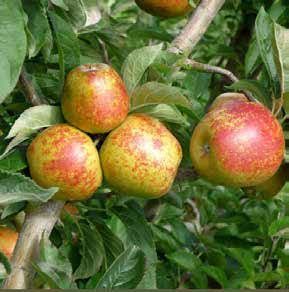
Blenheim Orange was discovered as a seedling growing against the boundary wall of Blenheim Park, Woodstock in Oxfordshire by a George Kempster, a local man in about 1740.
He planted it in his garden where it is said that “thousands thronged from all parts to gaze on its ruddy, ripening orange burden”. He called it Kempster’s Pippin until Biggs, a nurseryman from Worcestershire obtained permission from the Duke of Marlborough to market the variety as Blenheim Orange in 1818. It won the Banksian Silver Medal in 1822 and then was widely grown in the UK until the 1930’s. It was replaced by modern varieties in commercial nurseries but still remains a favourite garden variety.
Blenheim Orange is both an eating and a cooking apple. The tree is very vigorous and can grow up to 4 metres tall and is a partial tip- bearer. The trees are self- sterile triploids and need a pollinator from groups 2,3 and 4. The apples can be harvested from late September to early October and can be stored until November or December.
The apples can be large with an orange-red flush over a greenish yellow skin. They can also be speckled with fine brown russet spots and patches. The flesh is creamy white with a distinctive dry, nutty flavour. It will cook to a stiff puree and is said to be very good for an apple charlotte.